The problem
Company metrics lived in a SaaS BI tool with a real yearly cost, and new dashboards depended on a few people. Each upstream application schema change also meant hours of manual dbt modeling.
From business problem to technical problem
The first job is translation. Here is how the ask changed shape before any code was written.
- Business askLeadership needs metrics it can trust, and the SaaS BI tool is costly and slow to extend.
- Technical questionA BI platform on shared, tested definitions that teammates can safely extend, with data models that keep up with a changing application schema.
- What success looks likeLeadership reviews metrics on it, and teammates ship dashboards without a gatekeeper.
Paths I weighed
There was more than one reasonable way to do this. These are the options I compared and why I picked one.
Stay on the current SaaS tool
Upside. No build effort.
Cost. Ongoing license cost and limited AI-native workflows.
Switch to another SaaS tool
Upside. Faster than building.
Cost. Migration cost without solving extensibility.
Build in house on tested dbt models
Upside. Lower cost, AI-native, and fits the existing stack.
Cost. Requires real ownership and a testing culture.
What I built
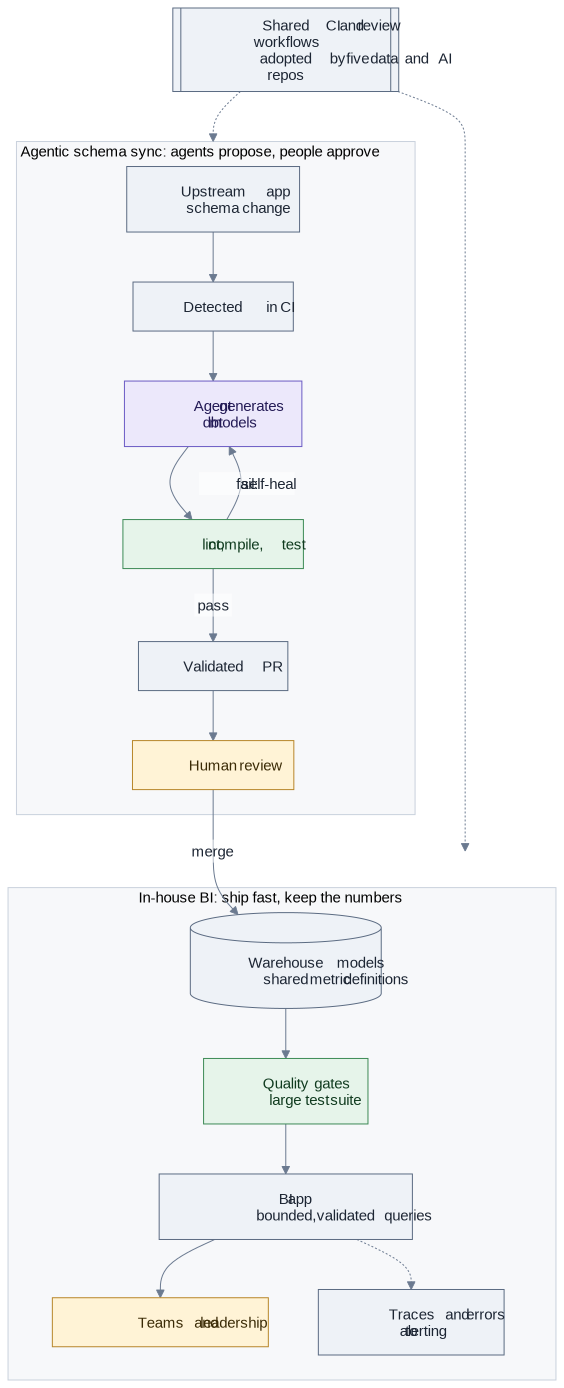
- Warehouse modelsShared, tested metric definitions
- BI platformAI-native, built in house
- Quality gatesA large test suite before anything ships
- Shared CIReview workflows across five repositories
- Schema syncAgentic dbt updates as reviewable PRs
The agentic dbt schema sync detects upstream application schema changes, generates dbt models, runs a self-healing lint, compile, and test loop, and opens a validated pull request. Hours of manual modeling per change became a single review.
How it got built, scaled, and fixed
- Build
Built from zero, with quality gates from the first dashboard.
- Scale
Shared CI and review workflows across the data team’s repositories, and containerized builds that made CI substantially faster.
- Fix
Each upstream schema change used to mean hours of manual modeling. An agentic workflow now turns it into a validated pull request for review.
Decisions that mattered
Tests let a team ship without a gatekeeper
Quality gates with a deep test suite let teammates publish dashboards independently, with confidence the numbers hold.
Agents propose, people approve
Schema sync ends in a validated pull request, never an automatic migration, so a human always reviews the change.
Make the fast path the standard
Shared CI and review workflows were adopted across five data and AI repositories, and containerized builds made CI substantially faster.
Mentor through review
Test-coverage coaching became a team-wide standard, and reviews caught metric errors before they reached executive and investor dashboards.
What transfers
Standards scale people. Tests, shared CI, and agent-proposed but human-reviewed changes let a team move independently without losing trust in the numbers.
Methods
Collaborative work with product and engineering partners; this page describes my contribution. Diagrams are simplified.