The problem
The customer’s backlog held orders with required dates, multiple stops, and piece counts. Turning it into loads meant choosing which orders ride together, in what sequence, and whether each move should go full truckload (FTL) or less than truckload (LTL).
A plan is only useful if planners can execute it as is, so the output had to respect their real constraints, not an idealized version.
From business problem to technical problem
The first job is translation. Here is how the ask changed shape before any code was written.
- Business askThe customer’s planners spend too long turning backlogs into loads, and shipping costs more than it should.
- Technical questionA constrained allocation problem: assign orders to stops and loads, choose FTL or LTL, respect required dates, and minimize cost per piece.
- What success looks likePlans the planners execute as is, compared against their baseline allocation on the same orders.
Paths I weighed
There was more than one reasonable way to do this. These are the options I compared and why I picked one.
Planner rules of thumb
Upside. Familiar and transparent.
Cost. Doesn’t scale, and leaves cost on the table.
Chase the exact optimum every run
Upside. The best objective on paper.
Cost. Too slow to iterate on, and hard for planners to trust.
Constraint-faithful, fast, ranked options
Upside. Planners compare candidate plans and recognize their own rules in them.
Cost. Trades a little theoretical optimality for speed and trust.
What I built
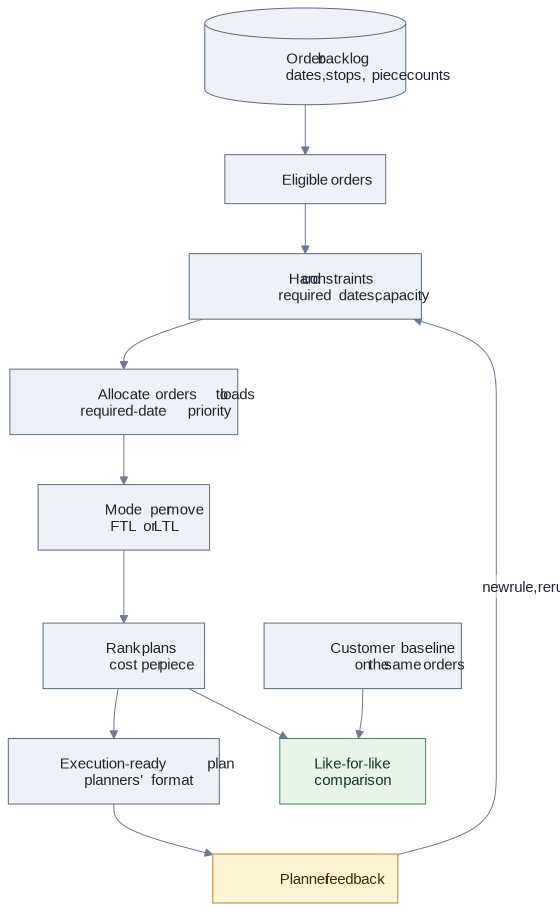
- Order backlogRaw customer orders, dates, and stops
- AllocationStop-level allocation with required-date priority
- Mode choiceFTL or LTL for each move
- RankingCandidate plans ranked by cost per piece
- Shipment planExecution-ready output for planners
How it got built, scaled, and fixed
- Build
I encoded the constraints with the planners, so the first plans already looked like theirs.
- Scale
Made runs several times faster, so a full planning cycle fit inside a working day.
- Fix
Each round of customer feedback became the next release, until the customer adopted it.
Decisions that mattered
Encode the planner’s rules
Required dates and stop constraints are hard constraints and cost is the objective, so planners recognize their own plan in the output.
Fast enough to iterate
A planning run originally took 14 hours. Cutting it to 2 hours 35 minutes turned it into something we could rerun as the customer’s needs changed.
Compare like for like
Plans were simulated against the customer’s baseline allocation on the same orders, so the cost difference reflects the method.
What transfers
A plan nobody runs is worth nothing. Encoding the operator’s real constraints and iterating with them mattered more than the last few percent of the objective, and speed mattered because it made iteration possible.
Methods
Collaborative work with product and engineering partners; this page describes my contribution. Diagrams are simplified.