The problem
Proof-of-delivery documents arrive as photos, scans, and PDFs from drivers and warehouses. Before automation, people matched each document to its shipment and checked it by hand, and invoices waited on that review.
Attribution was the first blocker: very few documents arrived reliably linked to their shipment.
From business problem to technical problem
The first job is translation. Here is how the ask changed shape before any code was written.
- Business askInvoices wait on someone checking delivery paperwork. Can we get paid faster without paying for mistakes?
- Technical questionClassify, attribute, and validate each document, and know which results are safe to approve automatically.
- What success looks likeAccuracy on automatically processed documents, measured by randomized audits, with uncertain cases routed to people.
Paths I weighed
There was more than one reasonable way to do this. These are the options I compared and why I picked one.
Keep full manual review
Upside. Maximum control.
Cost. Slow, costly, and grows with volume.
Automate everything
Upside. Fastest.
Cost. Errors flow straight into invoices, with no way to tell which ones.
Automate by confidence, audit continuously
Upside. Captures most of the volume safely and keeps quality measured.
Cost. Needs calibration and an ongoing audit habit.
What I built
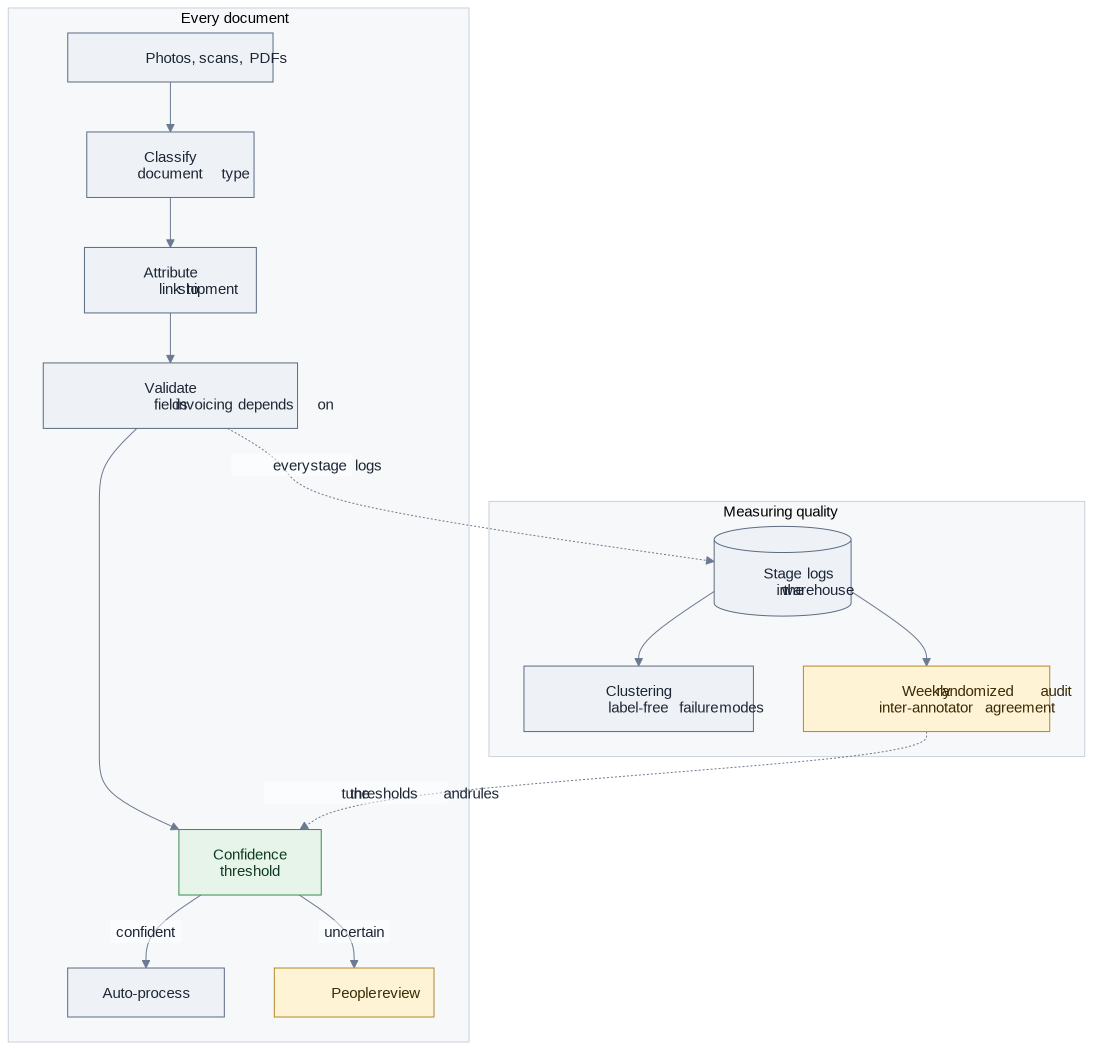
- ClassifyIdentify the document type on arrival
- AttributeLink each document to its shipment
- ValidateAI checks of the fields invoicing depends on
- RouteConfident results auto-process; the rest go to review
- AuditWeekly randomized audits feed back into quality
I led the validation system end to end and defined the evaluation methodology and metrics for the wider document-processing pipeline. I also led its migration to a more scalable, lower-cost workflow.
How it got built, scaled, and fixed
- Build
Before any labels existed, unsupervised clustering surfaced the main failure modes.
- Scale
Weekly randomized audits with inter-annotator agreement kept accuracy measured as volume and document mix grew.
- Fix
When cost and throughput became the constraint, I led the migration to a more scalable, lower-cost workflow.
Decisions that mattered
Measure quality without labels
Unsupervised clustering gave a label-free view of quality, surfacing failure modes before any annotation budget was spent.
Audit continuously
Weekly randomized audits with inter-annotator agreement keep accuracy measured rather than assumed as document mix changes.
Automate what is confident
Confidence thresholds send uncertain documents to people. I also designed the confidence-threshold policy engineering adopted for automated invoice matching.
What transfers
Start measuring before you can label. Unsupervised structure gives an early, honest view of quality, and small randomized audits keep it honest once the system is live. Automate the confident cases and send the rest to people.
Methods
Collaborative work with product and engineering partners; this page describes my contribution. Diagrams are simplified.